Showing posts with label Ann Lewis Clegg. Show all posts
Showing posts with label Ann Lewis Clegg. Show all posts
Sunday, January 18, 2015
12 Characteristics of 12 Impressive Ancestors
I thought I would share some of the outstanding characteristics of our ancestors. Most of these individuals have more complete stories elsewhere on this blog. These are characteristics that have impressed me and are worthy of emulation by their descendants.
Perseverance-Jensine Marie Jensen Moulton
Mary was one of three plural wives who moved to Old Mexico to try to keep the Joseph Moulton family together. Things didn't work out when the law against polygamy caused her husband to live with his first wife and "Mary" did her best to provide for her family. First as a seamstress, then a store owner. She ran boarding houses in Utah and California and cared for many years for her invalid daughter.
Overcoming Obstacles-Emma Amelia Croft Chase
Emma Amelia Croft would settle for nothing less than a temple marriage in the Logan Temple. Amelia wrote letters to her fiance's Centerville Bishop to help Frank get his temple recommend. Twenty-five years into their marriage, her husband deserted their family of nine children. She did the best she could to carry on as a single mom. She passed away in 1933 in the home of her daughter, Clairissa Chase Weiss, before knowing whatever happened to her husband.
Taking Risks-George Ogden Chase
George Ogden was unafraid to try. He fearlessly headed west with his family in 1847 as a young boy of 15. One risk he took was marrying Emily Hyde, the Apostle Orson Hyde's daughter. Emily had a home in Farmington and was mother to six of George's children. She felt George was away from home to much and eventually asked to be divorced and moved to California. George was obedient to the Prophet Brigham Young when Brigham suggested he take the young school teacher, Josephine Streeper, as a plural wife. Fifteen children were born to that union. George helped build the mill at Liberty Park and another mill in Farmington. He discovered natural gas in Ogden and built the first bicycle track and lakeside resort on the shores of the Great Salt Lake. He was a farmer and respected in Chase Park, north of Centerville, UT. He was unafraid to take risks.
Creativity-John Croft
John was a branch president in England. He was a counselor in the Presidency on the boat as they crossed the ocean. He married into a respected family and brought his new wife with him to America in 1860. He did carpentry work on the Lion House, the Bountiful Temple and many of the fine homes in Salt Lake. He helped plan and build the canals in Enterprise/Peterson area. He helped his son in law, Frank Leslie chase, build the farmhouse that still stands in Centerville, UT. John Croft's Enterprise farmhouse and outbuildings were among the finest in Utah. He was an inventor and was among the first to use a power pump to irrigate his fields.
Hospitality-Phoebe Chase & Chase Family
Christmas was quite a production at Chase Park in Centerville, UT. The tradition of hosting all the extended family continued until Kate Chase's death in 1937. Kate learned from her mother, Josephine and her grandmother, Phebe. Phebe regularly hosted her son-in-law, Brigham Young, and his good friend, Heber C. Kimball, at their Liberty Park home. The Salt Lake Chase home was known a favorite "out of town" spot and the site of numerous dances, parties, and sleigh rides.
Generosity-Simon S. Weiss
Simon S. Weiss was a Jewish man with a very generous streak. When his wife's father disappeared, he was quick to take the family in and support them during difficult financial times. His mother-in-law, Amelia Chase, was cared for in his home until her death.
Devotion to Family-Hyrum Chase Moulton
Chase would lower the kitchen counters to make them easier for his eleven children to help their mother. He was continually remodeling and enlarging his Heber City home. His Ford Garage was "through the block" and water filled inner tubes brought fun to all the neighborhood kids in summer. He left his business in Heber and worked as a plumber in Wyoming and in Salt Lake to provide for his large family during the depression. His children all learned to thread pipes and dig ditches after school to help him in his work.
Developing a Talent-Margaret Lillian Moulton
Lilly played the organ for church functions from the time she was eight years old. For many years she accompanied soloists and played the hymns for funerals all over Wasatch County. Lilly could have been a concert pianist or a tabernacle organist according to her professor at Brigham Young Academy. Instead, she became a mother of eleven very musical children, helping them each develop their own musical talents.
Work-Henry Clegg, Jr.
Henry Clegg, Jr. was a beloved Conference President in England for many years before leaving to come to America. With help from the Perpetual Emigration Fund, he planned to bring his wife, Hannah Eastman, and his two sons, to Zion. In Kansas his wife became ill and died from cholera. A few days later his infant son passed away as well and was carried back to be buried in his mother's arms. Henry came to Utah and married two more wives. He worked hard to provide for his large family in Salt Lake, then Springville, and was an early settler in Heber Valley. He was always teaching his 25 sons how to work to provide for their families. He was a cobbler, kept cattle and sheep, worked a farm, made shingles, ran a grocery store and made time to become a beloved Bishop in Wasatch Stake, Heber City 2nd Ward.
Sisterhood-Ann Lewis and Margaret Griffiths-Plural Wives
Ann Lewis and Margaret Griffiths were sealed to their husband the same day by Brigham Young. They learned how to work well together and even sang and performed with their husband all over Provo/Springville. They sang in the choirs and worked with their husband to build up his new businesses. They supported him while he was Bishop in Heber. These sister wives respected each other and learned to work well together.
True Conversion-Isaac Chase
This good Quaker recognized restored truth and joined the LDS Church in 1840. As one member of the family wrote: "He left his wealth in New York and Nauvoo. He left his tools at Liberty Park but he always kept his testimony." "Father Chase" once spoke in General Conference. When asked to leave his mill at Liberty Park and move to Centerville, he did. We don't have all the details of his business dealings with Brigham Young, but we know he died faithful to the Gospel of Jesus Christ that he loved. Some family members felt Brigham had cheated Isaac in taking over the Liberty Park Mill property. Isaac said, "Land o' mercy, don't look at the faults and shortcomings of the people for your guidance. Look well to the principles of your Church!"
Testimony-Emma Amelia Mitchell Croft
Emma Amelia wrote a letter to her missionary son encouraging him to be patient with those who persecuted him. This letter to her son was read by a member of a mob in Arkansas who was about to tar and feather Frank. The ruffian's heart softened as he read of the missionary's mother counsel and Frank was allowed to leave unharmed. Emma Amelia was known for her powerful prayers.

Sunday, September 21, 2014
Look On The Side That’s Bright-The Life of Henry Clegg, Jr.
"Look On The Side That’s Bright" - The Life of Henry Clegg,
Jr.

Henry Clegg - My Hero
Bishop Henry Clegg is one of my heroes. His life is evidenced deep faith, sensitivity, great love, and
kindness. His musical talent has been
passed onto many of his descendants. He lived
looking for goodness in all situations. He could be the poster child for the modern #share goodness.
Henry Clegg wrote a poem that I have often enjoyed
reading:
Look on the side that’s bright;
Let Hope your bosom swell;
All things will turn out right
So whisper: “All is
well”.
I have one 90 page book entitled “Oh, Henry” that has been written
about the life of Henry Clegg, Jr. by Noal C. Newbold in 1998. At one time Clegg descendants produced a play about his life. (Another more complete 261 page pdf “From England to Utah” compiled by Chris Christiansen is available at the amazing Clegg Family History website: ww.clegghistory.org.)
Below are a few of the more interesting details about
Henry’s life.
Henry was 12 years old when Heber C. Kimball and other LDS
missionaries from America arrived in Preston England with the message of the
restored gospel of Jesus Christ.
Tradition says Henry’s father (Henry Sr.) ran a race to the River Ribble
in Preston to see who was to be the first baptized but lost the race to George
D. Watt, a younger man. (See Blog of
August 2014- Deep Roots, Henry Clegg, Sr. and Ellen Cardwell.)
 |
| River Ribble in Preston, England |
Pic of Preston England
Henry Clegg,
Jr., was baptized at age thirteen by Joseph Fielding in Preston and was associated with the Church in Preston for eighteen years,
meeting Brigham Young, Orson
Hyde, Parley P. Pratt, John
Taylor, Wilford Woodruff, George A. Smith, and John E. Page.
(See: http://welshmormon.byu.edu/Resources/pdf/7512.pdf
page 188.)
Henry was following the boot and clog making trade of his
father in Lancashire, England. He and
his wife of eleven years, Hannah Eastman, were saving means for ten years to
immigrate to Utah with their two sons.

Prior to leaving England, Henry had already suffered the loss of his
oldest son, Thomas, who was accidently burned to death in 1853.
In March of 1855, the Rose Place Branch of Liverpool
Conference, presented their Branch President, Henry Clegg, a “testimonial”
before leaving for “Zion”. (The original
testimonial is in LDS Historical Archives.)
It begins:
Dearly Beloved
President,
In presenting this testimonial
to you, we feel that words are inadequate to convey those sentiments of esteem
and regard that we have for you as a Brother, A Man of God and an Elder in
Israel.”
They also composed a three-stanza poem which reads in part:
“Farewell, dear Brother
Henry, Till we all shall meet again;
And may Brigham’s God
defend thee, Till Mount Zion thou doest gain,
Then may his spirit
still attend, And be with thee until the end.”
The Clegg family sailed from Liverpool, England in the American
steamship “Juventa” on March 31, 1855.

Juventa Ship Manifest
Liverpool, England to Philadelphia
7 May 1855
7 May 1855
145*
Henry Cleg 29
M Clockmaker England US
3 Packages
146*
Hannah Cleg 36
F Wife England United States
147*
Israel Cleg 5
M England United States
148*
Henry J. Cleg 10m M England United States
Six weeks later they landed in Philadelpia. They took a train to Pittsburgh and then a
steamboat down the Ohio River to St. Louis.
In June, Hannah died of cholera and was buried at Mormon
Grove (near Atchison, Kansas) along with her one year and 3 month old son,
Henry James. (Some sources say he was 3 years old).
Henry Clegg, Jr. and his son 6 year old son, Israel, joined
the Richard Ballantyne Company of 42 saints and 45 ox-drawn wagons. They left 1 July 1855 and four months later
arrived in Salt Lake Valley on September 25 1855. Thirty year old Henry was greeted by a Welsh
girl, Ann Lewis who eventually became his second wife. They settled in the 19th Ward in
Salt Lake City.
There still exists a copy of a paper signed by Brigham Young
giving Henry permission to be sealed to his third wife, Margaret Ann Griffiths.
 |
| Signature of B. Young in the lower left quadrant. |
Some sources say Brigham Young sealed them in the Endowment
House. Margaret Griffgiths was a young
17-year old immigrant girl who lost three members of her family in the early
snows faced by the Martin Handcart Company in 1856. Margaret was taken into the Clegg household
while she was recovering from frostbite.

In 1859, Henry moved his family to Springville and then
joined other men in Echo Canyon holding back the invasion of Johnston’s
Army. He decided to stay in Springville,
UT where he became a leading citizen. He
was a fine musician and he played the dulcimer for dances. His dulcimer can still be seen in the Provo
Museum on 5th West and 6th North. There are 3 surviving dulcimers that
were built by Henry and his sons. All were
built out of wood from Big Cottonwood Canyon. The wire and pegs were brought
from England.

 |
| Henry Clegg's Dulcimer in the Provo City Museum on 5th West 6th North. |
Henry organized and directed a 60-voice choir in
Springville. Both of his wives were good
singers and would sing with him when he gave lectures in nearby wards and
towns. He continued his shoemaking trade
and managed to make one pair of shoes a year for each member of the family.
In 1872, Henry Jr. and his family moved on to Heber City in
order to better provide opportunities for his sons.
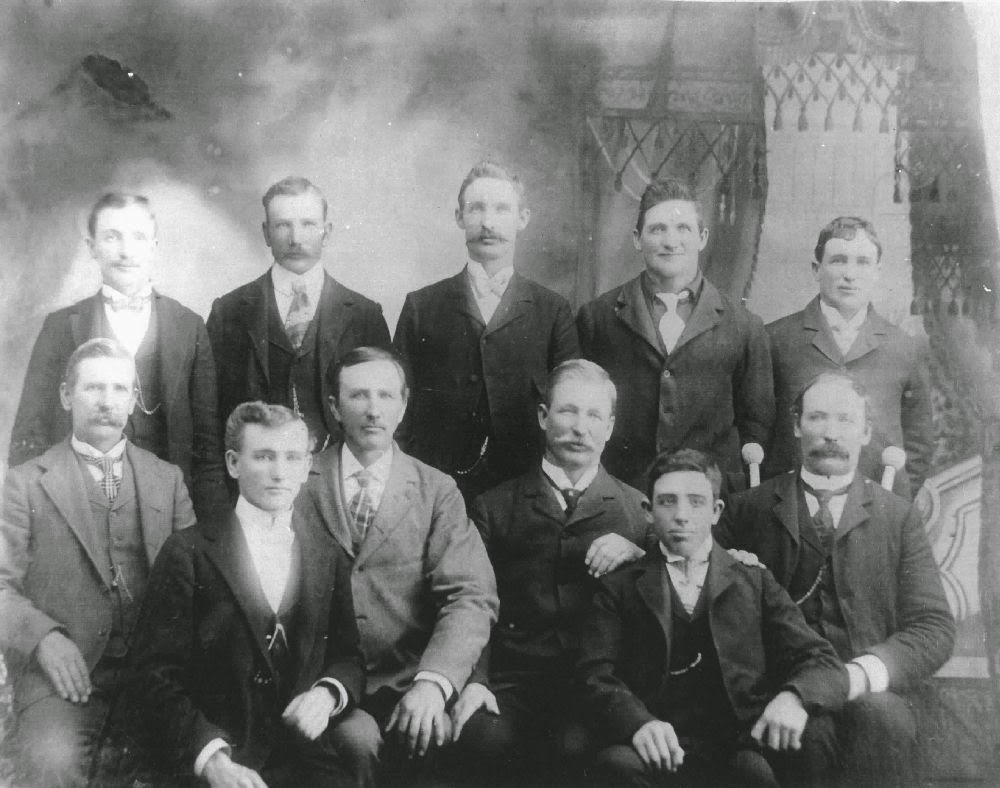 |
| Sons of Henry Clegg, Jr. |
In Heber, he homesteaded the southeastern
portion of Heber and he farmed, raised stock, and worked a saw and shingle mill
in Clegg’s Canyon. The Clegg family also
worked a rock quarry.
 |
| Clegg Canyon near Heber City, Wasatch County, Utah. |
 |
| Apparently there is a hiking trail up Clegg Canyon in Wasatch County. |
Bishop Clegg wrote many poems and hymns. His Christmas Hymn
was published in the Springville, UT Telegraph and can be found at the Clegg
Family site (www.clegghistory.org).
Henry Clegg was an expert mathematician and helped with
surveying the canals in Heber Valley. (While searching for other family members we
found the documents for the transfer of property in Strawberry Reservoir area
in the Duschene County records before the Wasatch County was formed.) He was part of the director of the Lake Creek
Irrigation in 1888. He was Justice of the Peace for a number of
terms. In 1884 he was an officer of the Heber Dramatic Combination.
Later he worked the mercantile trade and ran the store on Center Street that
also helped support his wives after his death. Elsie Clegg Condie wrote, “Tenderhearted Henry Clegg, Jr. never killed
a living creature. He hired his pigs
butchered and stayed away from home until they were dressed.”
Henry Clegg died at the age of 69 years on 30 August 1894 of
a heart attack while working in the store.
He left two widows, Anne Lewis Clegg and Margaret Griffiths Clegg to
provide for the family. His funeral was
noted in the local paper with “A Good Man has Gone. The people universally mourn his loss. The Stake House was profusely draped. The longest funeral Procession ever held in
the County.” (See the article at the
There were 12 pall bearers carrying the casket from the
Clegg home to the Stake Tabernacle. The
Tabernacle was still draped for the mourning of the death of President Garfield
who was assassinated in July. There were
120 teams in the procession to Heber City Cemetery. (Wasatch Wave, 4
Sept. 1894).
 |
| Clegg headstone in Heber City, Utah Cemetery. Many of our ancestors are buried here. We would do "grave rubbings" of Henry's headstone when we visited the cemetery. |
Henry
Clegg, Jr. and his wives Ann Lewis and Margaret Griffiths are buried together in the Heber
City, Utah Cemetery. There is a tall monument with the west facing side having
the inscription:
IN MEMORY OF
HENRY
CLEGG
BORN
JUNE 7, 1825
BAMBER BRIDGE
WALTON LE DALE
LANCASHIRE. ENG.
DIED
AUG. 30. 1894
The base
of the monument is inscribed with:
CLEGG
A loving husband a father dear
A faithful friend he has been here
He lived in love he died in peace
We hope his joys will never cease
 |
| Inscription on Henry Clegg headstone in Heber City Cemetery. |
The
North facing side is inscribed for Ann Lewis Clegg, and the Southside is
inscribed for Margaret Griffith Clegg. Their graves are in front of the
monument, with Henry in the middle, Ann to the North and Margaret to the South.
 |
| Clegg Family Headstone in Heber City, Utah. |
Another interesting fact was that the old Clegg home was used from 1920-1925 for LDS Seminary
classes. When the old Clegg home was
torn down, the materials were used to build the Seminary Building. Today the location where the old home once stood (next to the old Heber High School) is a City park.
Widowed Margaret Griffiths Clegg lived at 100 West and 300 South until her death in 1929. This "newer" home is still standing on the northwest corner.

Widowed Margaret Griffiths Clegg lived at 100 West and 300 South until her death in 1929. This "newer" home is still standing on the northwest corner.
 |
| Clegg home in Heber City, UT today. |
Here is the entire poem about “Look on the Side That’s
Bright”:
I like to think that these might have once been lyrics to a
hymn that Henry sang with his two wives:
Look on the side that’s bright;
Let Hope your bosom swell;
All things will turn out right
So whisper:
“All is well”.
Suppose the times are hard,
‘tis useless to look sad.
It can no help afford
And invites the sad..
If troubles fill your breast-
They also come to me;
It may be for the best,
That grief at times we see.
If we the bitter taste
We more enjoy the sweet,
And oft’ from dregs of waste,
Spring joys that are complete.
Seas are not always still
Oft’ angry billows roll,
And test the sailor’s skill
His vessel to control.
Our hearts can find relief
Our burdens be made light
If we in facing grief
Look on the side that’s bright.
And so Henry Clegg, Jr. lived, looking on the side that’s
bright.
It seems that Henry’s motto was similar to that of a modern
prophet, Gordon B. Hinckley:
“It isn't as bad as you sometimes think
it is. It all works out. Don't worry. I say that to myself every morning. It
all works out in the end. Put your trust in God, and move forward with faith
and confidence in the future. The Lord will not forsake us. He will not forsake
us. If we will put our trust in Him, if we will pray to Him, if we will live
worthy of His blessings, He will hear our prayers.”
― Gordon B. Hinckley
― Gordon B. Hinckley
May we “sing” with our most honorable ancestor, Henry Clegg:
Look on the side that’s
bright;
Let Hope your bosom swell;
All things will turn out
right
So whisper: “All is well”.
Subscribe to:
Posts (Atom)