Showing posts with label John Croft. Show all posts
Showing posts with label John Croft. Show all posts
Sunday, January 18, 2015
12 Characteristics of 12 Impressive Ancestors
I thought I would share some of the outstanding characteristics of our ancestors. Most of these individuals have more complete stories elsewhere on this blog. These are characteristics that have impressed me and are worthy of emulation by their descendants.
Perseverance-Jensine Marie Jensen Moulton
Mary was one of three plural wives who moved to Old Mexico to try to keep the Joseph Moulton family together. Things didn't work out when the law against polygamy caused her husband to live with his first wife and "Mary" did her best to provide for her family. First as a seamstress, then a store owner. She ran boarding houses in Utah and California and cared for many years for her invalid daughter.
Overcoming Obstacles-Emma Amelia Croft Chase
Emma Amelia Croft would settle for nothing less than a temple marriage in the Logan Temple. Amelia wrote letters to her fiance's Centerville Bishop to help Frank get his temple recommend. Twenty-five years into their marriage, her husband deserted their family of nine children. She did the best she could to carry on as a single mom. She passed away in 1933 in the home of her daughter, Clairissa Chase Weiss, before knowing whatever happened to her husband.
Taking Risks-George Ogden Chase
George Ogden was unafraid to try. He fearlessly headed west with his family in 1847 as a young boy of 15. One risk he took was marrying Emily Hyde, the Apostle Orson Hyde's daughter. Emily had a home in Farmington and was mother to six of George's children. She felt George was away from home to much and eventually asked to be divorced and moved to California. George was obedient to the Prophet Brigham Young when Brigham suggested he take the young school teacher, Josephine Streeper, as a plural wife. Fifteen children were born to that union. George helped build the mill at Liberty Park and another mill in Farmington. He discovered natural gas in Ogden and built the first bicycle track and lakeside resort on the shores of the Great Salt Lake. He was a farmer and respected in Chase Park, north of Centerville, UT. He was unafraid to take risks.
Creativity-John Croft
John was a branch president in England. He was a counselor in the Presidency on the boat as they crossed the ocean. He married into a respected family and brought his new wife with him to America in 1860. He did carpentry work on the Lion House, the Bountiful Temple and many of the fine homes in Salt Lake. He helped plan and build the canals in Enterprise/Peterson area. He helped his son in law, Frank Leslie chase, build the farmhouse that still stands in Centerville, UT. John Croft's Enterprise farmhouse and outbuildings were among the finest in Utah. He was an inventor and was among the first to use a power pump to irrigate his fields.
Hospitality-Phoebe Chase & Chase Family
Christmas was quite a production at Chase Park in Centerville, UT. The tradition of hosting all the extended family continued until Kate Chase's death in 1937. Kate learned from her mother, Josephine and her grandmother, Phebe. Phebe regularly hosted her son-in-law, Brigham Young, and his good friend, Heber C. Kimball, at their Liberty Park home. The Salt Lake Chase home was known a favorite "out of town" spot and the site of numerous dances, parties, and sleigh rides.
Generosity-Simon S. Weiss
Simon S. Weiss was a Jewish man with a very generous streak. When his wife's father disappeared, he was quick to take the family in and support them during difficult financial times. His mother-in-law, Amelia Chase, was cared for in his home until her death.
Devotion to Family-Hyrum Chase Moulton
Chase would lower the kitchen counters to make them easier for his eleven children to help their mother. He was continually remodeling and enlarging his Heber City home. His Ford Garage was "through the block" and water filled inner tubes brought fun to all the neighborhood kids in summer. He left his business in Heber and worked as a plumber in Wyoming and in Salt Lake to provide for his large family during the depression. His children all learned to thread pipes and dig ditches after school to help him in his work.
Developing a Talent-Margaret Lillian Moulton
Lilly played the organ for church functions from the time she was eight years old. For many years she accompanied soloists and played the hymns for funerals all over Wasatch County. Lilly could have been a concert pianist or a tabernacle organist according to her professor at Brigham Young Academy. Instead, she became a mother of eleven very musical children, helping them each develop their own musical talents.
Work-Henry Clegg, Jr.
Henry Clegg, Jr. was a beloved Conference President in England for many years before leaving to come to America. With help from the Perpetual Emigration Fund, he planned to bring his wife, Hannah Eastman, and his two sons, to Zion. In Kansas his wife became ill and died from cholera. A few days later his infant son passed away as well and was carried back to be buried in his mother's arms. Henry came to Utah and married two more wives. He worked hard to provide for his large family in Salt Lake, then Springville, and was an early settler in Heber Valley. He was always teaching his 25 sons how to work to provide for their families. He was a cobbler, kept cattle and sheep, worked a farm, made shingles, ran a grocery store and made time to become a beloved Bishop in Wasatch Stake, Heber City 2nd Ward.
Sisterhood-Ann Lewis and Margaret Griffiths-Plural Wives
Ann Lewis and Margaret Griffiths were sealed to their husband the same day by Brigham Young. They learned how to work well together and even sang and performed with their husband all over Provo/Springville. They sang in the choirs and worked with their husband to build up his new businesses. They supported him while he was Bishop in Heber. These sister wives respected each other and learned to work well together.
True Conversion-Isaac Chase
This good Quaker recognized restored truth and joined the LDS Church in 1840. As one member of the family wrote: "He left his wealth in New York and Nauvoo. He left his tools at Liberty Park but he always kept his testimony." "Father Chase" once spoke in General Conference. When asked to leave his mill at Liberty Park and move to Centerville, he did. We don't have all the details of his business dealings with Brigham Young, but we know he died faithful to the Gospel of Jesus Christ that he loved. Some family members felt Brigham had cheated Isaac in taking over the Liberty Park Mill property. Isaac said, "Land o' mercy, don't look at the faults and shortcomings of the people for your guidance. Look well to the principles of your Church!"
Testimony-Emma Amelia Mitchell Croft
Emma Amelia wrote a letter to her missionary son encouraging him to be patient with those who persecuted him. This letter to her son was read by a member of a mob in Arkansas who was about to tar and feather Frank. The ruffian's heart softened as he read of the missionary's mother counsel and Frank was allowed to leave unharmed. Emma Amelia was known for her powerful prayers.

Buffalo Bill and John Croft
 | |
| Buffalo Bill Cody |  |
William Frederick "Buffalo Bill" Cody was one of the most well-known figures of the Old West. He visited Salt Lake City and Temple Square on Dec. 7, 1892. It turns out that Mark Weiss is related to Buffalo Bill. They are 14th cousins through a common ancestor, Jan Arundel. (See BYU's Relative Finder.)
According to MadeinWyoming.net, 35 years prior to his visit to Temple Square, "he joined Johnston’s Army as an unofficial member of the scouts assigned to guide the Army to Utah to put down a falsely-reported rebellion by the Mormon population of Salt Lake City."

Buffalo Bill was also
a friend of John Croft (July 16, 1836-October 9, 1909). Cody quite likely furnished buffalo meat to the Croft Boarding Train in Kansas. John was likely a major factor in action taken by Colonel Cody to relinquish his water rights in the Shoshone River to the Mormon settlers against the vigorous opposition of his partner. Cody had just started the settlement of the Town of Cody, Wyoming (1900) and had started the construction of his "Irma Hotel", named for his daughter, and was anxious to have the Morons as neightbors. The Irma Hotel is still operating in Cody.


When John’s grandson, Alfred Russell Croft (b.1896) was 10 years old, John said to him, “Russell, Buffalo Bill’s circus is in Ogden and I want you to take this silver dollar and go to see his 'Wild West Show'. If I were well enough I’d go to Ogden with you and call on him in his tent. I’m sure he would give me the best reserved seats in the show.”
Russell wrote:
"This impressed me immensely to know that my Granddad was such a close friend of the famous Colonel William F. Cody. years later I was to learn that Colonel Cody probably furnished buffalo meat to John Croft's Rock Island Railroad boarding train in Kansas and Colorado in the 1880s. "
John Croft and Amelia Mitchell Croft-Pioneers of 1860, p. 27
Alfred Russell Croft wrote in 1973: "This happened about September 1904 standing at the back gate of the Croft ranch house in Enterprise, Morgan County, Utah... This is the most vivid recollection I have of grandfather John Croft.”
When John’s grandson, Alfred Russell Croft (b.1896) was 10 years old, John said to him, “Russell, Buffalo Bill’s circus is in Ogden and I want you to take this silver dollar and go to see his 'Wild West Show'. If I were well enough I’d go to Ogden with you and call on him in his tent. I’m sure he would give me the best reserved seats in the show.”
Russell wrote:
"This impressed me immensely to know that my Granddad was such a close friend of the famous Colonel William F. Cody. years later I was to learn that Colonel Cody probably furnished buffalo meat to John Croft's Rock Island Railroad boarding train in Kansas and Colorado in the 1880s. "
John Croft and Amelia Mitchell Croft-Pioneers of 1860, p. 27
 |
| Playbill for the Wild West Show. |
Alfred Russell Croft wrote in 1973: "This happened about September 1904 standing at the back gate of the Croft ranch house in Enterprise, Morgan County, Utah... This is the most vivid recollection I have of grandfather John Croft.”
Alfred Russell Croft was born on July 29, 1896 in Ogden, Utah and wrote a self-published autobiography entitled OUT OF OUR PAST A Brief History of Alfred Russell Croft Sr. and Irene Hutchings Croft. (c. 1973). Mark Weiss has one copy of the book that previously belonged to Claire Chase Weiss. (This book might be available online as the LDS Family History Library has been creating PDF files of similar personal history books.)
Dana Palmer has
compiled a wonderful short biography of John Croft with many photos found at http://dvrbs.com/people/CamdenPeople-JohnCroft.htm.
 |
| Turns out that Mark Weiss is related to Buffalo Bill. They are 14th cousins through a common ancestor, Jan Arundel. |


Monday, October 27, 2014
The Mysterious Frank Leslie Chase
 |
| Frank Leslie Chase |
Frank was the oldest son of George Ogden Chase and Josephine Streeper Chase. He was born November 8, 1865 at Chase Park in Centerville, Utah
 |
| Josephine Streeper Chase, mother of Frank Leslie Chase. |
 |
| George Ogden Chase, father of Frank Leslie Chase. |
Josephine noted (and Claire quoted): "He was high strung, nervous and very uncompromising in matters of injustice. he completed the schools in Davis County and graduated as a school teacher from the University of Deseret (Now U of Utah) under Dr. Park. He sometimes had to carry provisions for the week from Centerville to Salt Lake and do his own housekeeping to stay in school, but received his necessary credits and a contract to teach school in the town of Peterson, Morgan County, UT, 60 miles east of Salt Lake."
"Frank would engage in religious argument...and (with) his inability to keep his voice to a modulated tone in his arguments, he soon obtained a reputation of 'Doubting Thomas'. He did not fit in so well with his sisters friends, and their busy social lives and he "resented as any boy would, the sisters" domination and soon his high temper became evident, so that his standing the the Church was not above question."
Frank took a job teaching school in Peterson and meets his future partner in life, Amelia Croft, while rooming at the Croft home. Josephine describes her father Frank as "a meticulous young man with never a crease in his trousers and a tie that was so correct that he could not think without taking it into consideration." He enjoyed staying the English gentleman, John Croft, and was welcomed by Emma Amelia Croft (the mother) into a loving family with eight sons and two daughters.
 |
| John Croft and Amelia Mitchell Croft, parents of Emma Amelia Croft and in-laws of Frank Leslie Chase. |
"During the time he was in Enterprise, Frank regained some of his lost faith. Frank became again a well adjusted person and greatly was this to be attributed to his growing live for Amelia (John Croft's oldest daughter). Through all the trials of later years, her sane thinking and rock of Gibralter character, made her stick to the ship to the day of her death."
 |
| Emma Amelia Croft, wife of Frank Leslie Chase. "She would stick to the ship to the day of her death." |
Emma Amelia, a faithful Latter-day Saint, desired to be married only in the "Holy Temple of God." She wrote a letter to Frank's Centerville Ward Bishop (dated Dec 16, 1891), unbeknownst to Frank, hoping to persuade the Bishop that her future spouse was indeed temple worthy. We also have a copy of another letter written by Frank himself (dated Nov 22, 1891). "It is my desire to obtain a Recommend to the Temple to attend to the work for my departed brother, David, and also to take to myself a partner in life which I wish to do int he proper way and I am hoping now, Bishop that you will see the thing in the proper light and also see fit to extend as my desire. I remain your well intentioned and earnest believer in the work in which we are engaged and ever trying to inform myself concerning my duties and the duties of every Latter-day Saint." (See full text of both letters on pages 6-7 of biography written by Josephine Chase Bradshaw).
Frank is able to advance in the priesthood and obtain his temple recommend. They are married in the Logan Temple on February 3, 1892. Frank was 27 and Amelia 24. It appears that Frank's father, George Ogden Chase did attend as Frank's escort however, Frank's mother, Josephine Streeper Chase, was unable to attend. (See "Josephine Diaries" in possession of Cyndy Weiss.)
Josephine C. Bradshaw writes: "The Chase family chartered a railroad car to take the wedding guests from Salt Lake to Peterson (East Weber in Morgan County) for the large reception at the bride's home "which included the greater part of Morgan County and a special care of guests from Salt Lake City."
The newly weds then stayed in Enterprise for another year until a home was built in Chase Park, Centerville.
The "Farmhouse" was finished in 1893. Frank's father-in-law, John Crofts, was a skilled carpenter and supervised the building and did much of the work. The Croft's also helped furnish the new home with three oak bedroom sets, a dining room set of oak and many other items. There were 3 bedrooms upstairs and one bedroom, parlor, dining room and large kitchen in this house.
At first, Frank Leslie Chase went to work in Salt Lake for McCornick & Company bankers.
Frank and Amelia had been married for only 4 years when his mother (Josephine Streeper Chase) died (July 20 1894, age 59) and then 2 years later his father (George Ogden Chase, age 64) died (May 5, 1896). Frank was only 31 and now responsible for the farm, two families, and his unmarried brother and sisters. The Chase sisters convinced him to quit his banking job and come back to manage the farm.
Later, Frank became "the postmaster of the the fourth class" and worked in an office just opposite the town store. Apparently he played a fine game of checkers with Brother Harris and others who could spare th time when he was not dispensing service or giving out mail, writing out money orders and registering mail. In the summers, Ella, Frank's sister, would relieve him at the post office so he could go home and run the farm.
Claire Weiss wrote: "My father and mother loved music--my father played the flute in the County band, and I think we had one of the first Columbia phonographs in the county. We were among the first in the county to have telephone, electric lights.
"My father had a mine in the mountains East of our property and he would spend time every fall up there. He built a shanty and had a stove and bed and cooking utensils. Some samples assayed with a small amount of gold, but the problem was how to get it down. He also had a lab in one of the buildings on the place and he worked in the winter on perpetual motion. He had another man who worked with him."
Frank worked hard at providing for his family and keeping up the Chase "family image". His oldest sister, Kate, seemed to be unhappy at the way Frank took care of the Chase estate following the death of their father. (See various stories recorded by Josephine Chase Bradshaw, page 10.)
 |
| Kate Chase, older sister of Frank Leslie Chase. |
Josephine, Frank's oldest sister, wrote that from the beginning of his life, "Frank was more or less dominated by his sisters. He was conscientious and anxious to do right, but had more of his mother's disposition" than that of his father.
By the time he was 44 Frank, and Amelia (41), had 9 children. Amelia's father, John Croft died in 1909 at the age of 73.
In 1911, Frank's son, David Harold Chase, died in a hunting accident in the Centerville hills at 3:00 on Sunday afternoon. Claire Chase (Weiss) was 11 and just two years older than her brother David. Apparently this accidental shooting affected Frank deeply. The funeral was "one of the largest funerals ever held in Centerville". (See article from David County Clipper below.)

The Davis County Clipper (11-03-1911) is especially descriptive about the horse in the procession from Chase Park to the Centerville Cemetery: "The pall bearers led the deceased boy's horse which was saddled and bridled but a large wreath was fastened to the saddle in place of a rider being in it."
 |
| David Chase, son of Frank Chase died at age 9. |
In 1912, Frank joined the Progressive Party and was County Chairman. He took his entire family to the Centerville rally and he held rallies in all parts of Davis County.
1914 was a pivotal year. Frank, age 49, was injured in a car accident. In the fall he was driving to Tooele to buy a trashing machine. He hit a cow and was thrown from his car and tears the ligaments in his arms. From then on he is unable to use his arms in lifting and is unable to work the farm.
The doctor who was treating Frank thought he should go to the Steven's ranch in Idaho. Frank worked on his "mental well being" for a year in Idaho and then returned to his family, still unable to do any kind of work that required lifting. The oldest son, John "Jack" Howland Chase, is on his LDS mission to Hawaii. The family hires a friend to take the loads of vegetable to town.
In 1915 Frank is somewhat improved but still can't run the farm. The farm and house were rented and the Chase family moved to Salt Lake City to 538 Lowell Avenue. Frank was 50 and Amelia was 47 and the children are ages 6-23.
In 1916 the family moved to 168 M Street and Frank begins working as a night watchman. In 1917 the family moved again, this time to 145 North State, a house owned by relatives.
In 1918 Jack returned from his mission and the family moves to "C" Street in the Spring. Claire was 18 and married Simon Weiss on June 5th. Frank, 53, left Utah to go to work in Idaho. Frank sent one letter telling the family that all was going well. That was the last they heard from Frank. Amelia was 50 years old and still had three kids in grade school.
1921 is when the cousins go back to New Jersey to visit with their "rich" Croft cousins for 3 months. Two of the children, Josephine (29) and Jack (25) are married in 1921 and the family moved into Miller Apartments.
In 1922 Mother Amelia Chase (54) moved in with Claire and Simon Weiss. George is still in grade school.
In 1924 Claire and Simon Weiss move to California to look for employment there. (See "Dauntless, Fearless, Hopeful" blog entry.) The Chase Family moves into the Fairmont Apartments. On Thanksgiving, Mother Amelia becomes ill and goes to the hospital. Claire and Bea come home from California to be with their mother. Claire Weiss moves into 1363 Thornton Avenue.
1925 Amelia Croft Chase (57) leaves the hospital and comes to the Weiss home, where her daughter Claire cared for her. Mother Amelia passed away on March 27th. Frank Leslie Chase is unaware of his wife's death because he has been gone for seven years. George is in high school and lives with the Weiss family while attending East High in Salt Lake City.
 |
| Emma Amelia Croft Chase died in the home of her daughter, Clairissa Dean Chase Weiss. |
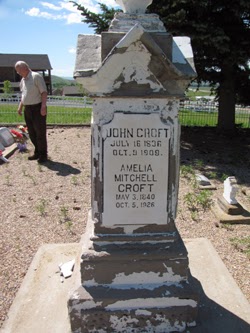
The following year, in 1926 the mother of Amelia Chase, Amelia Emma Mitchell Croft, dies at age 86. (She is buried with other Croft family members in the small fenced family plot located in Enterprise, Morgan County, Utah.)
 |
| Amelia Mitchel Croft, mother-in-law of Frank Leslie Chase. |
In 1933, Frank's youngest son, George, marries. Frank Leslie dies on December 12, 1933 in Skulley Town, Texas at the age of 68 having missed 15 years of his family's life.
 | |
| The Frank Leslie Chase Family in 1930's. |
For 15 years the Frank Leslie Chase family struggles on without knowing what happened to their father and did their best to make ends meet. Without the help of generous family members, including Simon S. Weiss, they would have suffered even more. In 1933 the family received notification from someone in Skelly Town, Texas, that Frank is deceased. Apparently he died from heart failure.
 |
| Newspaper notice about the death of Frank Leslie Chase in December 1933. |
The lessons from the life of Frank Leslie Chase seem to be difficult ones. Each life is a story to be written. The Author starts each life story, but each life will write his or her own ending." (Max Lucado).
We are grateful that Frank fathered 9 children, among them, our dear Clairissa Dean Chase Weiss. Claire was the first of Frank's children to marry (1918) and the last of the nine children to die (1991).
 |
| Clairissa Dean Chase Weiss, daughter of Frank Leslie Chase. |
It is true that life's challenges help to reveal one's character and mental state. There is no way to judge all that happened to Frank Leslie Chase. Why did he make the choices he did? We will likely never know "the rest of" this story. We simply remain grateful that he gave life to our ancestor Claire Chase Weiss.
Saturday, October 18, 2014
The Bountiful Tabernacle and John Croft
The Bountiful Tabernacle is one of just three 19th century Mormon buildings in the world still used for weekly Sunday services. Our ancestor, John Croft, played a part in its construction.
Located at Main and Center streets in Bountiful, Utah, it remains an example of pioneer craftsmanship. You can't drive by this building with its unusual spire and not think of the pioneers.
It has been a landmark since it's completion in 1863. It was designed by Augustus Farnham and began in 1857. John Croft worked on it during 1861. It was dedicated by Elder Heber C. Kimball on 14 March 1862. It was added to the National Register of Historic Places in 1976. In 2005 a new spire replaced the original.
John was born July 16, 1836 in Primose Hill, Yorkshire, England. His father, John, was a coachman. An accident took his father’s life when
John Jr. was only 6 years old. His
widowed mother was left with 5 children to care for. He began working 8 hours a day in a
“worsted mill” and attending school two hours a day.
When he was 12 his
mother died. He lived with his eldest
sister and went to work in a large tobacco factory. He “did not use the weed”. He attended night school and at age 17
became apprenticed to a joiner and builder.
At the end of three years he was released and went to Liverpool. He was a natural mechanic and after a few
months was appointed foreman at the firm that employed him.
One day as John walked
the streets of London, he observed a pamphlet on the sidewalk and put it in
his pocket. Later that day on his
lunch break he began to read the pamphlet and a friend leaned over and said,
“Are you a Mormon?” John said he wasn’t. His friend told him he was a Mormon and
that the tract was one distributed by Mormon missionaries. John was taught by
his co-worker and eventually baptized on June 27, 1856 at the age of twenty.
His employer tried to get him to leave the Mormons.
John then moved to
Manchester to work on the Exposition Building. He labored as a traveling Elder in the
Manchester Conference and on January 1, 1858 was made president of that
Conference.
John met his wife
Amelia Mitchell in the Manchester Conference. He married Amelia Mitchell of
Manchester January 8, 1860, at Heaton Norris in Manchester, England.
John continued to serve
as president of the Manchester Conference until released to come to
Utah. 594 Mormons, many of them of
members of the John’s Manchester branch, emigrated on the “Underwriter” to
America leaving Liverpool on March 29 1860. They were among many who used the Perpetual Emmigration Funds to make their trip to America and Ziion.
John and Amelia were newlyweds and about to embark on a new life
together. John was a counselor to Elder James D. Ross. The Millenial Star wrote: "The health of
the Saints was generally good. Elders Ross, Taylor, and Croft speak in
the highest praise of Captain J. W. Roberts, both as a skillful
navigator and a gentleman."
"DEPARTURE OF THE SHIP UNDERWRITER. -- The ship Underwriter, Captain Roberts, cleared on Wednesday the 28th of March, and sailed for New York on Friday the 30th. There were on board 594 souls of the Saints, under the presidency of Elder James D. Ross, assisted by his counsellors, James Taylor and John Croft. This number included 70 souls from Switzerland, and the remainder from the British Mission. Nearly the whole of this emigrating company of Saints are en route direct for Utah, the home of the Saints. God speed and bless them abundantly on their journey!"
MS, 22:15 (April 14, 1860), p.234 "THE SHIP UNDERWRITER, after a prosperous voyage of thirty days, arrived at New York May 1st. During the voyage there were four marriages and four deaths. The names of the deceased are -- Frederick, the son of John and Eliza Williams, aged one year and eight months; Joseph, son of Edward and Mary Powers; Barbara Frei, aged 58 years, came form Switzerland. The health of the Saints was generally good. Elders Ross, Taylor, and Croft speak in the highest praise of Captain J. W. Roberts, both as a skillful navigator and a gentleman. The ship's company of Saints proceeded to Florence on the 3rd of May." MS, 22:21 (May 26, 1860), p.331
After 32 days they
arrived in New York on May 1, 1860.
They took a train from NY to Florence Nebraska, arriving on May 8,
1860. They walked across the plains in the John D. Ross Company, 249 people,
36 wagons. John was the captain of
the guard. The young Croft family arrived in Utah September 2, 1860 with
Amelia being pregnant with their first child.
Amelia spoke of the
pioneer trek: “When we stopped at noon
we baked a mixture of flour and water over a fire made of buffalo
chips.”
When they arrived in
Emigration Canyon by apostles George A. Smith, Lorenzo Snow, and Franklin D.
Richards. A few days later they
arrived in the Great Salt Lake Valley on September 3, 1860. Their first son was born two and a half
months later while they were at Pioneer Square on November 24, 1860. John and Amelia resided in the Salt Lake
City 8th ward for a short period.
John had been a
cabinet-maker in England and so began to work as a carpenter on the Public
Works. He helped build the tithing
office (once stood where the Hotel Utah-JS Memorial Building now stands), the
Lion House, the impressive Walker Home (where the Newhouse Hotel now stands).
John and his close friend from England, John Oliver, took the contract to build the Bountiful Utah Tabernacle. He worked in Bountiful until the spring of 1861 when he moved to Weber Valley, settling at Weber City (now Peterson, Morgan County). The Tabernacle was completed in 1863, so we don't know how long he worked in Bountiful before his move to Peterson-Enterprise area.
John and Amelia Croft
would become the parents of eleven children, and their daughter, Emma Amelia,
would later marry Frank Leslie Chase, son of Isaac and Josephine Chase.
While living in Enterprise, John used his considerable skills to build up his farm in Morgan County. One of his descendants drew a diagram showing all the outbuildings in 1890.  (See earlier post about "Furniture made in Paris?" John Croft might have bought this piece on a trip to Europe with his wealthy New Jersey brother and manufacturer, Howland Croft.)
John Croft died
October 9, 1909 in Enterprise (Morgan County) of diabetes. He is buried
with members of his family in a small family plot about 15 minutes outside of
Ogden.
For more information, see John Croft and Amelia Mitchell Croft : pioneers of 1860 Written by Alfred Russell Croft, Sr. (grandson). Mark Weiss, great-great grandson of John Croft, has a copy of this book. It was digitized in 2014 and is available through the LDS Genealogical Library. (https://familysearch.org/eng/library/fhlcatalog/) |


Monday, February 10, 2014
Furniture "Made in Paris"?

Was this furniture “Made in Paris”?
John
Croft (1836-1909) joined the Church of Jesus Christ of Latter-day Saints in
1856 in Liverpool, England while an apprenticed to a joiner and builder. He went to Manchester and later became
president of the Manchester Conference in 1858.
John came to America in 1860 with his newlywed wife, Amelia Mitchell
(1840-1926). They were married January
8, 1860 in Lancashire, England.
 There
were over 594 Mormon passengers, most using resources from of the Perpetual
Immigration Fund, who boarded the ship “Underwriter”. John Croft was a counselor to Elder J. D.
Ross on their 32 day trans-Atlantic voyage.
They arrived in New York on Amelia’s 20th birthday, May 3,
1860. Then they traveled by train to
Winter Quarter’s (Florence, Nebraska).
From there they walked across the plains in the John D. Ross
Company. Amelia was pregnant with their
first child as she walked the 1200 miles (at about 15-20 miles a day) from June
17, 1860 and arriving in Salt Lake Valley on September 2, 1860. (See
http://history.lds.org/overlandtravels.)
There
were over 594 Mormon passengers, most using resources from of the Perpetual
Immigration Fund, who boarded the ship “Underwriter”. John Croft was a counselor to Elder J. D.
Ross on their 32 day trans-Atlantic voyage.
They arrived in New York on Amelia’s 20th birthday, May 3,
1860. Then they traveled by train to
Winter Quarter’s (Florence, Nebraska).
From there they walked across the plains in the John D. Ross
Company. Amelia was pregnant with their
first child as she walked the 1200 miles (at about 15-20 miles a day) from June
17, 1860 and arriving in Salt Lake Valley on September 2, 1860. (See
http://history.lds.org/overlandtravels.) After
working as a carpenter on public works projects in Salt Lake and
Bountiful (Lion House and the Bountiful Tabernacle), the young family
moved in the spring of 1861 to Peterson in Weber Canyon. Four years later in 1865 the Crofts decided
there was not enough sunshine on the west side of the Weber River Valley
because of the high mountains to the west, so they purchased a farm in the town
of Enterprise on the east side of the river.
(Apparently their old Peterson log cabin was still standing in
1973. I wonder if it is still
there?) The Croft family burial plot
surrounded by the iron fence remains in the “purple valley of Morgan
County.”
After
working as a carpenter on public works projects in Salt Lake and
Bountiful (Lion House and the Bountiful Tabernacle), the young family
moved in the spring of 1861 to Peterson in Weber Canyon. Four years later in 1865 the Crofts decided
there was not enough sunshine on the west side of the Weber River Valley
because of the high mountains to the west, so they purchased a farm in the town
of Enterprise on the east side of the river.
(Apparently their old Peterson log cabin was still standing in
1973. I wonder if it is still
there?) The Croft family burial plot
surrounded by the iron fence remains in the “purple valley of Morgan
County.”
John’s
brother, Howland, immigrated to America six years after John in 1867 and set up
a prosperous yarn manufacturing mill in Camden, New Jersey (Howland Croft
Sons and Company Linden Worsted Mill.) Howland never joined the church but stayed in
contact with his Utah Mormon relatives.
The New Jersey Howland Croft family often came and visited their “poor
Mormon cousins” and the John Croft family received all expense paid trips to
visit their New Jersey “rich Gentile cousins.”
In
1890 the two brothers, John and Howland Croft, decided to take a trip to
England and France. John’s wife, Amelia, was invited to go, but she declined
saying, “One trip across the Atlantic
was enough for me.”

The
two brothers went to England and France to see family members and gather some
genealogy information. While in France they bought valuable furniture in Paris
that was shipped back to Utah.
Grandchildren tell of the “furniture in the Parlor at the Croft ranch
house. It was "somewhat of a "no-no" room, with curtains
and blinds drawn and used only on very state occasions. The furniture consisted
of four Queen Ann type chairs and a sofa, all covered with braided
horsehair." Alfred Russell Croft, Out of Our Past, p. 19,
1973.)
We
don’t know what happened to all that furniture from Paris, but I can make a
guess. John Croft’s granddaughter,
Claire Chase Weiss inherited some of the furniture (maybe the red horsehair
sofa and possibly the end tables?) and passed on the two end tables to her son,
David Weiss. When David’s wife, Marilyn, died, D. Mark Weiss, John’s
great-great-grandson, ended up with the two beautiful end tables.
Maybe
the end tables were simply purchased by Simon and Claire Weiss but since we
never asked those who knew now we will likely never know the origin of this
furniture. How did it get preserved and
handed down to us? What happened to the
rest of the Paris furniture? If indeed
these are pieces from the Croft “Paris purchase”, then they have likely
travelled from Paris, France to New York, USA, to Ogden, Utah, to Enterprise,
UT, to Salt Lake City, UT, to Centerville, UT, to Portland, OR, to Redmond, WA,
to Vancouver, WA and then to Logan, UT.
If they could speak, imagine what stories these tables could tell!
Did
the carpenter craftsman of John Croft’s youth admire the fine
 workmanship? Did Amelia Mitchell Croft lovingly polish these pieces? Did Great-Grandma Claire Chase Weiss think of
her Croft ancestors and times with her cousins when she saw the end
tables? Did Grandpa David Weiss know how
he inherited this furniture?
workmanship? Did Amelia Mitchell Croft lovingly polish these pieces? Did Great-Grandma Claire Chase Weiss think of
her Croft ancestors and times with her cousins when she saw the end
tables? Did Grandpa David Weiss know how
he inherited this furniture?
Now
my own grandchildren love to look inside the small drawers in the end tables
and play with the knickknacks inside. It
is now my turn to polish and preserve it and wonder where it came from. We will likely never know. As the Nigerian proverb states: “When
an old man dies it is like a library set ablaze.”
What do you wish you could ask those who have already
“passed on”? Do you have a question
about an item you have inherited? How
did some of your family traditions began?
Do you wonder about the unidentified photos you have seen? Perhaps a child asks why you make a recipe in
that peculiar way and you respond, “Well, that’s the way my mother taught
me.” We need to ask these kinds of
questions of our living ancestors before they “cross over”.

For now, the Paris furniture question
remains in my mental file labeled “Family Mysteries”. Author David McCullough believes “You
scratch the supposedly dead past anywhere and what you find is life.” Maybe we will yet find out how this
scratched furniture came into the Weiss family.
Subscribe to:
Posts (Atom)