The Bountiful Tabernacle is one of just three 19th century Mormon buildings in the world still used for weekly Sunday services. Our ancestor, John Croft, played a part in its construction.
Located at Main and Center streets in Bountiful, Utah, it remains an example of pioneer craftsmanship. You can't drive by this building with its unusual spire and not think of the pioneers.
It has been a landmark since it's completion in 1863. It was designed by Augustus Farnham and began in 1857. John Croft worked on it during 1861. It was dedicated by Elder Heber C. Kimball on 14 March 1862. It was added to the National Register of Historic Places in 1976. In 2005 a new spire replaced the original.
John was born July 16, 1836 in Primose Hill, Yorkshire, England. His father, John, was a coachman. An accident took his father’s life when
John Jr. was only 6 years old. His
widowed mother was left with 5 children to care for. He began working 8 hours a day in a
“worsted mill” and attending school two hours a day.
When he was 12 his
mother died. He lived with his eldest
sister and went to work in a large tobacco factory. He “did not use the weed”. He attended night school and at age 17
became apprenticed to a joiner and builder.
At the end of three years he was released and went to Liverpool. He was a natural mechanic and after a few
months was appointed foreman at the firm that employed him.
One day as John walked
the streets of London, he observed a pamphlet on the sidewalk and put it in
his pocket. Later that day on his
lunch break he began to read the pamphlet and a friend leaned over and said,
“Are you a Mormon?” John said he wasn’t. His friend told him he was a Mormon and
that the tract was one distributed by Mormon missionaries. John was taught by
his co-worker and eventually baptized on June 27, 1856 at the age of twenty.
His employer tried to get him to leave the Mormons.
John then moved to
Manchester to work on the Exposition Building. He labored as a traveling Elder in the
Manchester Conference and on January 1, 1858 was made president of that
Conference.
John met his wife
Amelia Mitchell in the Manchester Conference. He married Amelia Mitchell of
Manchester January 8, 1860, at Heaton Norris in Manchester, England.
John continued to serve
as president of the Manchester Conference until released to come to
Utah. 594 Mormons, many of them of
members of the John’s Manchester branch, emigrated on the “Underwriter” to
America leaving Liverpool on March 29 1860. They were among many who used the Perpetual Emmigration Funds to make their trip to America and Ziion.
John and Amelia were newlyweds and about to embark on a new life
together. John was a counselor to Elder James D. Ross. The Millenial Star wrote: "The health of
the Saints was generally good. Elders Ross, Taylor, and Croft speak in
the highest praise of Captain J. W. Roberts, both as a skillful
navigator and a gentleman."
"DEPARTURE OF THE SHIP UNDERWRITER. -- The ship Underwriter, Captain Roberts, cleared on Wednesday the 28th of March, and sailed for New York on Friday the 30th. There were on board 594 souls of the Saints, under the presidency of Elder James D. Ross, assisted by his counsellors, James Taylor and John Croft. This number included 70 souls from Switzerland, and the remainder from the British Mission. Nearly the whole of this emigrating company of Saints are en route direct for Utah, the home of the Saints. God speed and bless them abundantly on their journey!"
MS, 22:15 (April 14, 1860), p.234 "THE SHIP UNDERWRITER, after a prosperous voyage of thirty days, arrived at New York May 1st. During the voyage there were four marriages and four deaths. The names of the deceased are -- Frederick, the son of John and Eliza Williams, aged one year and eight months; Joseph, son of Edward and Mary Powers; Barbara Frei, aged 58 years, came form Switzerland. The health of the Saints was generally good. Elders Ross, Taylor, and Croft speak in the highest praise of Captain J. W. Roberts, both as a skillful navigator and a gentleman. The ship's company of Saints proceeded to Florence on the 3rd of May." MS, 22:21 (May 26, 1860), p.331
After 32 days they
arrived in New York on May 1, 1860.
They took a train from NY to Florence Nebraska, arriving on May 8,
1860. They walked across the plains in the John D. Ross Company, 249 people,
36 wagons. John was the captain of
the guard. The young Croft family arrived in Utah September 2, 1860 with
Amelia being pregnant with their first child.
Amelia spoke of the
pioneer trek: “When we stopped at noon
we baked a mixture of flour and water over a fire made of buffalo
chips.”
When they arrived in
Emigration Canyon by apostles George A. Smith, Lorenzo Snow, and Franklin D.
Richards. A few days later they
arrived in the Great Salt Lake Valley on September 3, 1860. Their first son was born two and a half
months later while they were at Pioneer Square on November 24, 1860. John and Amelia resided in the Salt Lake
City 8th ward for a short period.
John had been a
cabinet-maker in England and so began to work as a carpenter on the Public
Works. He helped build the tithing
office (once stood where the Hotel Utah-JS Memorial Building now stands), the
Lion House, the impressive Walker Home (where the Newhouse Hotel now stands).
John and his close friend from England, John Oliver, took the contract to build the Bountiful Utah Tabernacle. He worked in Bountiful until the spring of 1861 when he moved to Weber Valley, settling at Weber City (now Peterson, Morgan County). The Tabernacle was completed in 1863, so we don't know how long he worked in Bountiful before his move to Peterson-Enterprise area.
John and Amelia Croft
would become the parents of eleven children, and their daughter, Emma Amelia,
would later marry Frank Leslie Chase, son of Isaac and Josephine Chase.
While living in Enterprise, John used his considerable skills to build up his farm in Morgan County. One of his descendants drew a diagram showing all the outbuildings in 1890.  (See earlier post about "Furniture made in Paris?" John Croft might have bought this piece on a trip to Europe with his wealthy New Jersey brother and manufacturer, Howland Croft.)
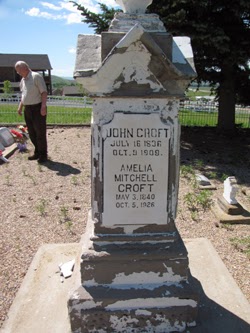
John Croft died
October 9, 1909 in Enterprise (Morgan County) of diabetes. He is buried
with members of his family in a small family plot about 15 minutes outside of
Ogden.
For more information, see John Croft and Amelia Mitchell Croft : pioneers of 1860 Written by Alfred Russell Croft, Sr. (grandson). Mark Weiss, great-great grandson of John Croft, has a copy of this book. It was digitized in 2014 and is available through the LDS Genealogical Library. (https://familysearch.org/eng/library/fhlcatalog/) |
Showing posts with label Bountiful Tabernacle. Show all posts
Showing posts with label Bountiful Tabernacle. Show all posts
Saturday, October 18, 2014
The Bountiful Tabernacle and John Croft


Monday, February 10, 2014
Furniture "Made in Paris"?

Was this furniture “Made in Paris”?
John
Croft (1836-1909) joined the Church of Jesus Christ of Latter-day Saints in
1856 in Liverpool, England while an apprenticed to a joiner and builder. He went to Manchester and later became
president of the Manchester Conference in 1858.
John came to America in 1860 with his newlywed wife, Amelia Mitchell
(1840-1926). They were married January
8, 1860 in Lancashire, England.
 There
were over 594 Mormon passengers, most using resources from of the Perpetual
Immigration Fund, who boarded the ship “Underwriter”. John Croft was a counselor to Elder J. D.
Ross on their 32 day trans-Atlantic voyage.
They arrived in New York on Amelia’s 20th birthday, May 3,
1860. Then they traveled by train to
Winter Quarter’s (Florence, Nebraska).
From there they walked across the plains in the John D. Ross
Company. Amelia was pregnant with their
first child as she walked the 1200 miles (at about 15-20 miles a day) from June
17, 1860 and arriving in Salt Lake Valley on September 2, 1860. (See
http://history.lds.org/overlandtravels.)
There
were over 594 Mormon passengers, most using resources from of the Perpetual
Immigration Fund, who boarded the ship “Underwriter”. John Croft was a counselor to Elder J. D.
Ross on their 32 day trans-Atlantic voyage.
They arrived in New York on Amelia’s 20th birthday, May 3,
1860. Then they traveled by train to
Winter Quarter’s (Florence, Nebraska).
From there they walked across the plains in the John D. Ross
Company. Amelia was pregnant with their
first child as she walked the 1200 miles (at about 15-20 miles a day) from June
17, 1860 and arriving in Salt Lake Valley on September 2, 1860. (See
http://history.lds.org/overlandtravels.) After
working as a carpenter on public works projects in Salt Lake and
Bountiful (Lion House and the Bountiful Tabernacle), the young family
moved in the spring of 1861 to Peterson in Weber Canyon. Four years later in 1865 the Crofts decided
there was not enough sunshine on the west side of the Weber River Valley
because of the high mountains to the west, so they purchased a farm in the town
of Enterprise on the east side of the river.
(Apparently their old Peterson log cabin was still standing in
1973. I wonder if it is still
there?) The Croft family burial plot
surrounded by the iron fence remains in the “purple valley of Morgan
County.”
After
working as a carpenter on public works projects in Salt Lake and
Bountiful (Lion House and the Bountiful Tabernacle), the young family
moved in the spring of 1861 to Peterson in Weber Canyon. Four years later in 1865 the Crofts decided
there was not enough sunshine on the west side of the Weber River Valley
because of the high mountains to the west, so they purchased a farm in the town
of Enterprise on the east side of the river.
(Apparently their old Peterson log cabin was still standing in
1973. I wonder if it is still
there?) The Croft family burial plot
surrounded by the iron fence remains in the “purple valley of Morgan
County.”
John’s
brother, Howland, immigrated to America six years after John in 1867 and set up
a prosperous yarn manufacturing mill in Camden, New Jersey (Howland Croft
Sons and Company Linden Worsted Mill.) Howland never joined the church but stayed in
contact with his Utah Mormon relatives.
The New Jersey Howland Croft family often came and visited their “poor
Mormon cousins” and the John Croft family received all expense paid trips to
visit their New Jersey “rich Gentile cousins.”
In
1890 the two brothers, John and Howland Croft, decided to take a trip to
England and France. John’s wife, Amelia, was invited to go, but she declined
saying, “One trip across the Atlantic
was enough for me.”

The
two brothers went to England and France to see family members and gather some
genealogy information. While in France they bought valuable furniture in Paris
that was shipped back to Utah.
Grandchildren tell of the “furniture in the Parlor at the Croft ranch
house. It was "somewhat of a "no-no" room, with curtains
and blinds drawn and used only on very state occasions. The furniture consisted
of four Queen Ann type chairs and a sofa, all covered with braided
horsehair." Alfred Russell Croft, Out of Our Past, p. 19,
1973.)
We
don’t know what happened to all that furniture from Paris, but I can make a
guess. John Croft’s granddaughter,
Claire Chase Weiss inherited some of the furniture (maybe the red horsehair
sofa and possibly the end tables?) and passed on the two end tables to her son,
David Weiss. When David’s wife, Marilyn, died, D. Mark Weiss, John’s
great-great-grandson, ended up with the two beautiful end tables.
Maybe
the end tables were simply purchased by Simon and Claire Weiss but since we
never asked those who knew now we will likely never know the origin of this
furniture. How did it get preserved and
handed down to us? What happened to the
rest of the Paris furniture? If indeed
these are pieces from the Croft “Paris purchase”, then they have likely
travelled from Paris, France to New York, USA, to Ogden, Utah, to Enterprise,
UT, to Salt Lake City, UT, to Centerville, UT, to Portland, OR, to Redmond, WA,
to Vancouver, WA and then to Logan, UT.
If they could speak, imagine what stories these tables could tell!
Did
the carpenter craftsman of John Croft’s youth admire the fine
 workmanship? Did Amelia Mitchell Croft lovingly polish these pieces? Did Great-Grandma Claire Chase Weiss think of
her Croft ancestors and times with her cousins when she saw the end
tables? Did Grandpa David Weiss know how
he inherited this furniture?
workmanship? Did Amelia Mitchell Croft lovingly polish these pieces? Did Great-Grandma Claire Chase Weiss think of
her Croft ancestors and times with her cousins when she saw the end
tables? Did Grandpa David Weiss know how
he inherited this furniture?
Now
my own grandchildren love to look inside the small drawers in the end tables
and play with the knickknacks inside. It
is now my turn to polish and preserve it and wonder where it came from. We will likely never know. As the Nigerian proverb states: “When
an old man dies it is like a library set ablaze.”
What do you wish you could ask those who have already
“passed on”? Do you have a question
about an item you have inherited? How
did some of your family traditions began?
Do you wonder about the unidentified photos you have seen? Perhaps a child asks why you make a recipe in
that peculiar way and you respond, “Well, that’s the way my mother taught
me.” We need to ask these kinds of
questions of our living ancestors before they “cross over”.

For now, the Paris furniture question
remains in my mental file labeled “Family Mysteries”. Author David McCullough believes “You
scratch the supposedly dead past anywhere and what you find is life.” Maybe we will yet find out how this
scratched furniture came into the Weiss family.
Subscribe to:
Posts (Atom)