Showing posts with label England. Show all posts

Wednesday, August 1, 2018

Small Coins in a Fruit Jar


My great-great-grandmother, Sarah Denton Moulton, saved coins in a fruit jar for about 15 years before the PEF (Perpetual Emigration Fund) made it possible for her family to gather with the LDS Saints in "Zion". 


Leaving behind England and going to America must have been a great act of great faith for her, her husband, Thomas, and their children.  Among the children was my great grandfather, Joseph.  He was eleven at the time they finally left England.  He probably knew what that fruit jar represented.  When the family ate only barley to try and pinch and save, he might have looked at the jar and thought about the family plan to gather with Saints in America.

 Perhaps with every coin Sarah placed in the jar, her own desire to make the journey increased.  It likely left an impression on all her children.  


In faith, Sarah was left her own extended family behind.  In faith, she stepped onto the Ship Thornton very close to delivering a child.  That baby, Charles Alma Moulton, was born on the Irish Sea.  One of his children remembers:  "He often mentioned that he was a man who had no country as a birthplace because he was born aboard the ship Thorton which sailed from Liverpool, England in May 1856." 


In faith, Sarah acted courageously.  She knew only a little of the danger ahead.   She was worried about the safety of her family, soon to be eight children.  It is recorded that she received a blessing from priesthood leaders in England promising her that not one member of her family would be lost.  

In the history written by one of Charles Alma Moulton's children there is this memory recorded:  

The family crossed the plains in the James G. Willey Mormon Pioneer Handcart Company to get to Utah in November of 1856. They suffered great hardship on the way and Dad was a little baby so thin he was hardly expected to survive. Kind people in Salt Lake helped the family and they all recovered after a while from the effects of the cold weary journey."   (Family Search, Life Sketch.)

As promised, not one member of the faithful Moulton family perished during the trek to Utah.


Royal Albert Docks is the number one tourist attraction in Liverpool.


Dr. S. Michael Wilcox expressed his deep feelings about walking on the Royal Albert Docks on June 27, 2017 and I share it below:


An English friend once gave me an 1844 half farthing as a memorial to all the poor British saints that saved, sometimes for years, the tiny coins, one by one, until they had enough to buy their passage to Zion. It is worn and smoothed by many fingers as it passed from hand to hand through the years. Now it rests in my own. I carry this coin with me when I go to England and finger it softly as I walk the dockside. It takes me back into the past and I can see it all as if it were my own memory, my own farewell—the ship resting securely moored to the riverfront, trunks and cloth bundles waiting to be loaded stacked pell-mell along the wharf, sacks of grain swinging precariously above the deck, sailors climbing the rope ladders and along the yardarms rhythmically moving to the music of their shanties. Everywhere there is bustle and hurry and business and excitement. I can hear the sounds of the loaded carts shaking along the cobblestones groaning under the burden of each families precious belongings, taste the warm freshness of scones pedaled in the streets, feel the rope roughness of the ships rigging stretched taut against the sails, smell the salt sea breeze coming off the Atlantic and up the river, see the fading evening light which heralds that last sacred day in England. Candles are flickering throughout the city and the ship’s lanterns sway on the night air as the stars blink into life over Liverpool Cathedral. There is homesickness in the air, yet there is also the call of the new land and all its promises.
Then there are the people. Mothers clutching the hands of tiny children fearful of losing them in the rush of hurried preparations, fathers firm faces trying so hard to hide their own anxieties and be strong for their families, young men huddled in tight masses speaking knowingly of what they do not really know, girls looking in the shop windows for that final stretch of ribbon or English lace to bring a memory of Europe to the log cabin wilderness into which they go. There is excitement, wonder, laughter, tears, longing and love washing across the riverfront, baptizing the red brick of the warehouses that still stand silently today as if they knew that they had witnessed God moving among his children directing them to a new world, new lives, new hopes. Were they not engaged in His work and was He not pleased with their sacrifices?
Some years ago, I also boarded a three-masted tall ship at the Albert Docks and sailed down the Mersey River. The fates were kind to me and I drew the position at the wheel. I steered a course straight down the river. The tide pulled the ship towards the Atlantic as the sails filled with the winds of England, a parting gift from the island that has become almost my own home. It seemed that all the hopes and dreams of tens of thousands sailed with me that evening. I looked back at the docks and could still see, over a century and a half later, the ghostly waving hands and handkerchiefs of loved ones left behind whose faces and voices our ancestors would never see nor hear again, and I thought of the words of one of them, my wife’s great-grandfather, who stood on these same docks framed by these same brick buildings, and sailed down the quiet waters of the Mersey toward America.
“We left Liverpool on the 18th of May. Seeing my native land gradually sink into the horizon gave me a feeling of loneliness and uncertainty. I realized how dear it was; containing all that had given me a fullness of joy. Loving parents, the companions of my childhood, all my relatives, faithful friends, the land I revered, the ancient castles whose ruins I loved to explore, the stately mansions, splendid cathedrals, green lanes, cozy cottages, the hills and vales, green fields and fragrant gardens ran through my mind. My path was separating us by an ocean, a continent, perhaps forever.”


I hope to one day have my own 1844 half farthing one day to show to my grandchildren.  Perhaps I will create a jar full of small coins to represent the sacrifices made by our ancestors so they could gather with the Saints to Zion.

Monday, August 4, 2014

Deep Roots-Henry Clegg, Sr. & Ellen Cardwell

Deep roots on trail to Mt. Timpanogas Caves, American Fork, Utah


In July our family was able to hike up American Fork Canyon to the Mt. Timpanogas Caves.  It was harder than we expected.  The trip up was challenging but the vistas were stunning and the rock tunnels and outcroppings made for a great experience.  

One interesting feature that caught my eye was the tree with its exposed roots pictured above.  Clinging to the rock for life and sending its roots deep, this little fir tree was a survivor.   In a way, I guess we are all survivors.  We seek for our required nourishment by sending our roots deep. 

The stories of our ancestors are like the deep roots.  They keep us grounded.  They provide nourishment, and sustain life, even when exposed on hot summer days.  They have survived many stormy winters and dry summers.  They have been tried and have survived.  There is a story in these roots.

Some time ago I posted the stories of the "First converts to Mormonism" (see Part 1 published on 2/22/14).  This post contains the story of another "first convert" in our Moulton family line.


Henry Clegg, Sr, & Ellen Cardwell.


Henry Clegg Sr. was baptized at age 49 on July 30, 1837.   He was the second man to be baptized in England by Heber C. Kimball in the River Ribble in Preston.  Henry Clegg, Senior lost the race to see who would be first baptized to a younger man, George Watts.

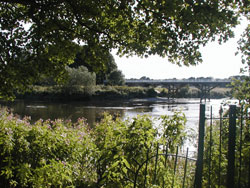
River Ribble Baptismal Site, Preston, Lancashire, UK

The information below was from: 

http://mormonhistoricsites.org/river-ribble-baptismal-site/

riverRibble_main
Site of the first baptisms in England
Photo courtesy of Alexander L. Baugh


The first LDS missionaries to Great Britain arrived in England in July 1837 and felt prompted to first journey to Preston. While there, they preached three times in the Vauxhall Chapel and several individuals petitioned them for baptism.

The first baptisms in England occurred on July 30, 1837 where nine individuals were baptized in the River Ribble in the presence of approximately eight-thousand onlookers. By August 6, nearly fifty individuals had been converted and Elder Heber C. Kimball organized a branch in Preston.1

Heber C. Kimball described the first baptisms as follows:
“I had the pleasure, about 9 a.m., of baptizing nine individuals and hailing them brethren and sisters in the kingdom of God. These were the first persons baptized into the Church in a foreign land, and only the eighth day after our arrival in Preston.
A circumstance took place which I cannot refrain from mentioning, for it will show the eagerness and anxiety of some in that land to obey the Gospel. Two of the male candidates, when they had changed their clothes at a distance of several rods from the place where I was standing in the water, were so anxious to obey the Gospel that they ran with all their might to the water, each wishing to be baptized first. The younger, George D. Watt, being quicker of foot than the elder, outran him, and came first into the water.” 2
Since those initial baptisms, the Preston area has remained an area of strength and the Preston England Temple was dedicated by President Gordon B. Hinckley on June 7, 1998.

=======

Henry Clegg, Sr. was a shoe and clog maker.

Clogs similar to those made by Henry Clegg, Sr.

When the call came to gather to Zion, Henry Sr. felt his wife was much too frail to make such a trip.  However, two of Henry's sons both came to America leaving Henry Senior and his wife, Ellen, in Walton Le Dale, a suburb of Preston.

Henry Clegg, Jr. was the youngest of the eight children and emigrated in at age 30 in 1855.  Henry Clegg, Jr.'s wife (Hannah Eastham) and young son (Henry Clegg III) both died near "Mormon Grove" near Atchnison, Kansas in 1855.

Jonathan Clegg was 9 years older and was part of the Willie Handcart Company in 1856.  The two sons of Henry and Ellen, (Henry Clegg, Jr. and Jonathan Clegg) would send money back to their parents.  We have copies of some of their correspondence.  (See Clegg Family History Site:  http://www.clegghistory.org/1856letter.htm).

Read a transcription of the 1856 letter from Henry Sr. to Henry Jr. at the website: http://www.clegghistory.org/1856letter.htm

Clegg Family Crest The sentence Qui potest capere capiat is Latin for "Let him who can take, take". It appears in the Latin (Vulgate) Bible at the end of Matthew 19:12, where it is translated "He who is able to receive this, let him receive it." in the Revised Standard Version.


There is an interesting story about the grave marker for Henry Clegg, Senior found here:  http://www.clegghistory.org/gravemarkerstory.htm.

Sandy and Craig Ostler were able to see the new headstone in 2007. 

This marker was placed by descendants in the Walton-Le-Dale Parish Church in 2000.  The quote was in a letter Henry Sr. wrote to Henry Clegg, Jr.

Tombstone of Henry Clegg Sr. and Ellen Cardwell

Placed at their Grave June 14th-15th, 2000


Halver and Miriam Clegg located the grave site at St. Leonard's Cathedral,
at Walton-Le-Dale, near Preston, England and the River Ribble.

The stone was designed and ordered by Cal and Gayle Clegg, and was made by
stone mason Mike McMurray of Preston, England.

When it was finished, Cal and Gayle Clegg, Milton and Mary Ellen Clegg, and Charles and Dixie Clegg (all three brothers) placed in on the grave.


In Remembrance of
HENRY CLEGG
of Walton-Le-Dale
Born 4th Aug. 1788
Died 9th Feb. 1865
ELLEN CARDWELL
Born 15th April 1788
Died 7th Oct. 1874


Who relied wholly on the
mercy of God in Christ Jesus.


It is interesting to note that at the time it was ordered, Ellen Cardwell's
resting place was not known. After placing the stone, they found her name in
the cemetery register, and she was indeed buried next to Henry. One of
their children who had passed away at a young age was buried near them also.

The quote is from the New Testament, in particular, from a passage that Henry
Sr. quoted in a letter to Henry Jr.


Cemetery Register for Henry Clegg, Sr.

Henry Clegg was registered in this book at the time of his death.
His name is listed 4th up from the bottom. It says:

771 Henry son of late Thomas Clegg Walton-le-Dale 77
d.d./dido (Old Age) (Feb.) 13th 5 42

The "5 42" specifies the location of his burial. The last column, which is
blank on Henry's entry, was a note about who it was. The vicar at the parish
explained that this was left blank when a person was very well known, as was
the case with Henry Clegg Sr.
 ======


How thankful I am for the faith of Henry Clegg, Sr. and his family "who relied wholly on the mercy of God in Christ Jesus."

Their roots went deep.  We are the beneficiaries of Clegg tenacity and strength.  These early converts clung to their faith as the pine tree clings to the cliff.   May we likewise cling to our faith in our Lord,  Jesus Christ. 


Monday, March 17, 2014

Thomas Moulton and Sarah Denton-Handcart Pioneers


Thomas Moulton was the "famous" ancestor I heard stories about in my youth. I am one of many  hundred Moulton descendants.  I was so impressed that some of his descendant had formed a Thomas Moulton Family Organization!  When we sang "Blessed Honored Pioneer" I would think of Thomas and Sarah.  I have since learned  much more about this venerated pioneer.   One new fact was that Thomas served as the hard working butcher on the Willie Handcart Company.   After trekking all day, he would come into camp and have to work some more.  Much additional information about him is found on LDS Family Search (click memories).

The Moulton Family joined the handcart pioneers of 1856.
"Thousands of immigrants from England and Wales who joined the Church and the trek west took on a new form of transportation to Salt Lake City. They couldn't afford wagons after leaving their homeland, so they pulled handcarts. The human-powered handcarts, which were envisioned by Brigham Young, proved to be one of the most brilliant—and tragic—experiments in all western migration."  (From the website http://history.lds.org/article/pioneer-story-iowa-city)

The more I learn of the experience of "ill fated" 1856 handcart companies, the more I admire this great man and his faithful wife.  The movie, "17 Miracles" has made the Moulton family's handcart experience even more vivid in my mind.

Thomas Moulton's 19 year old daughter, Sarah, wrote a letter and gave her impressions of the trek.

August 13, 1856:
"We are going to start for the plains to morrow—and there is not any more going this year so the brethren say.
...I feel it a great blessing that I am so far on my way to Zion and I feel still to go on for the farther I go the more I rejoice[.] I never enjoyed myself so well in my life before[.]
...Do not think of coming only by the hand carts for it is good[.] I never had my health so well in my life before I walked about three hundred miles and pulled the hand cart all the way and we walked sometimes 20 & 17 miles a day and I never had a blister on my foot & cannot think to tell you my feelings when I was coursing along the road but I often think of the prophet Brigham's words about the weak becoming strong[.] well I assure you I never was so strong in my life before[.] well I feel to thank the Lord for it for he has blessed me."  (See: http://history.lds.org/overlandtravels/)

I wonder how much of Sarah's attitude was a reflection of her father's faith?

I am grateful for all that faithful Thomas did to prepare the way for his many descendents.  His descendancy chart created on puzzilla.com is quite impressive and this is only 3 generations!
This is Thomas Moulton-3 generations of descendants-from Puzzilla.org.  Yellow is Hyrum Chase Moulton line.


The following information is taken from the book How Beautiful Upon the Mountains by the Daughters of the Utah Pioneers of Wasatch County pp. 525-527


For a more complete compiled history written by Verda Hicken, go to:
http://www.ourgrandmasandgrandpas.com/OurGrandmasAndGrandpas/Moulton/HIS_Thomas_Moulton.htm
=========

            Thomas Moulton was born in 1810 at Irchester, England.  When he was 22 he married Esther Marsh, a young woman eight years his senior.  They had two daughters:  Susan and Sarah.

            On February 25, 1839, Esther Marsh Moulton died leaving her husband and two-year old daughter Sarah.  A year later, in April 1840, Thomas Moulton married his second wife, Sarah Denton, who as born June 5, 1818, at Rushdown, Northampton, England.  She was the daughter of Charles Denton and Charlotte Bassfield.
            By 1838 several branches of the Church had been organized in England.  The missionaries were making many converts to the Church.  Thomas Moulton and his wife had become interested in the Latter-day Saint teachings and were baptized December 29, 1841.  However, it was not until 1856 that they were able to emigrate.  In the meantime, their first six children were born in Irchester, England.  The names of the children were:  Mary Ann, William Denton, Joseph (our ancestor), James Heber, Charlotte and Sofia Elizabeth.

            In England, Thomas Moulton was a farm laborer, and the undertaking of preparations for emigration of a family on nine, with a new member momentarily expected, was no small task.  Sarah, his oldest daughter by Esther Marsh, was now a young lady of 19.  His other six children, by Sarah Denton, ranged in age from three to fifteen.
This painting hung in the stairwell of the Wasatch Tabernacle for many years.
              Before leaving England, Thomas Moulton felt a little hesitant about undertaking such a long and strenuous journey.  His wife went to see one of the brethren, who gave her a blessing.  He promised her that she would make the journey safely without the loss of one member of her family.  Although their trials were severe and the baby, Charles, reduced to a near skeleton, their children who crossed the plains married and reared families.

            On May 03, 1856, the Moulton family set sail on the ship “Thornton” from Liverpool, England, with 764 passengers.
Moulton family traveled on the ship Thornton from Liverpool England to New York Harbor in 1856.

            While crossing the Irish Sea, Sarah Denton gave birth to her seventh child, Charles Alma.  After a six-week trip by water, the family, consisting of 10 members, arrived in New York harbor on June 14, 1856, and embarked by railroad for Winter Quarters, later leaving for Iowa City, where they arrived June 26.

            Upon arrival in Iowa City they found the handcarts were not ready, which caused three weeks delay.  Two hundred and fifty handcarts had to be made, many of them from green, unseasoned lumber, and were unable to stand the strenuous test that they were subjected to.  Several carts had to be abandoned on the plains.


            The Thomas Moulton Family was assigned to the James C. Willie Company, composed of 500 saints, including more that the usual number of aged.

            The first 200 miles of their journey was over beautiful grassy plains with flowers and wild fruits and plenty of fish in the streams.
Handcart Pioneer statue on Temple Square in Salt Lake City.
            When they reached Florence, Nebraska, it was necessary to repair many of the carts.  Some couldn’t be repaired and had to be left by the wayside.  The travelers were becoming tired and weary and unable to push or pull the heavily-loaded carts.  All unnecessary things were discarded.  The wagons and cattle were taken by the Indians, and provisions were becoming so low that food had to be rationed.  Many became ill and deaths increased daily.  Along with these and other difficulties, winter set in early and men, women and children were forced to wade through freezing streams, and to sleep in the open with insufficient bedding.  Through deep snows, piercing winds and freezing temperatures the company struggled on.  Sixty-six of their number died.

            Some Mormon missionaries returning from England overtook and passed the company and reported its plight to the Church presidency in Salt Lake City.  Immediately rescue parties were sent out carrying wagon loads of provisions, clothing and bedding.

            The Moulton family arrived in Salt Lake City on November 09, 1856, without losing one member of their family.  However, their third son, Heber, had had several fingers on his left hand frozen so badly that they had to be amputated on reaching Salt Lake.

            On December 05, 1856, their oldest daughter, Sarah, was married to John Bennett Hawkins, an established blacksmith, who had been a member of the rescue party, sent out by President Young.  They made their home in Salt Lake City, where they became a prosperous and influential family.

            Three weeks later the Thomas Moulton family moved to Provo, where he worked as a farm laborer.  Here their eighth child was born, Thomas Denton, on October 29, 1858.  He died 10 months later.  Here also their daughter, Mary Ann, was married to Fredrick Giles.  She was the mother of Fredrick W., John T. and Sarah Giles Mahoney.  Mary Ann and Fredrick moved to Heber, where she died at the age of 28.

            In 1860 the Moulton family moved from Provo to Heber.  As the settlers were having trouble with the Indians, they took refuge in the log fort built in 1859 and 1860.
Old Fort Heber


            On September 16, 1860, their ninth child, John E., was born and three years later the tenth and last, George Franklin.

            After moving from the fort, Thomas Moulton built the rock house on Second North and Second West. 

The Historic Thoms Moulton Home still stands in Heber City, UT


            He and his wife were both systematic and methodical in their work and planning.  They did their share in helping to pioneer Heber Valley.

Thomas Moulton   1810-1892
            Thomas Moulton was a Blackhawk War veteran in the infantry company of John Gallager.  Thomas died April 17, 1892.   Sarah Denton Moulton died July 07, 1888.  Both are buried in Heber City Cemetery.
Headstone of Sarah Denton and Thomas Moulton in the Heber City Cemetery